
 ,
Md. Monirul Islam*,
Pronabananda Das,
Mazedul Anwar Razib,
Ahmad Nazri Karim Mamun
,
Md. Monirul Islam*,
Pronabananda Das,
Mazedul Anwar Razib,
Ahmad Nazri Karim Mamun
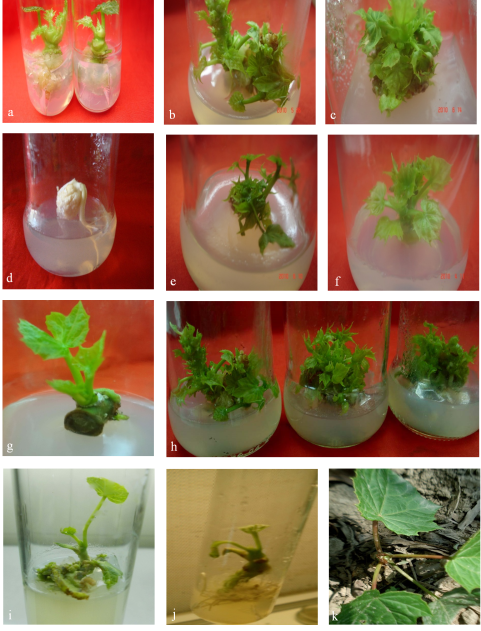
In vitro regeneration of Jatropha curcus L. was established from different explants such as shoot tips, cotyledons and nodal segments using different concentrations and combinations of plant growth regulators and additives. The nodal segments were found superior explants to shoot tips and cotyledons. The highest result obtained on multiple shoot formation from nodal explants using 2.0 mg/l BA + 2.0 mg/l kin. in MS supplemented medium, in which 70% of explants responded for multiple shooting after 30 days of inoculation period. The average number of shoots and leaves/explants were 4.2 0.64 and 2.90 0.42 in this medium 90 days after inoculation respectively. The average shoot length of 3.62 0.29 cm was also found in this same media and condition. Regenerated shoots were rooted well when transferred to of half strength of MS + 2.5 mg/l lBA, in which 50% of shoots responded after 30 days of inoculation period. The average number of roots/in-vitro raised shoots of 3.2 0.65 and the average root length of 3.5 0.29 cm were recorded in this medium after 60 days of inoculation. Plantlet regeneration was observed with low frequency in shoot tip and cotyledon explants. Most of the regenerants initially produced a clump of meristems and tended to form calli rather than multiple shoot formations.
| Published in | Plant (Volume 13, Issue 4) |
| DOI | 10.11648/j.plant.20251304.13 |
| Page(s) | 191-197 |
| Creative Commons |
This is an Open Access article, distributed under the terms of the Creative Commons Attribution 4.0 International License (http://creativecommons.org/licenses/by/4.0/), which permits unrestricted use, distribution and reproduction in any medium or format, provided the original work is properly cited. |
| Copyright |
Copyright © The Author(s), 2025. Published by Science Publishing Group |
Jatropha, Shoot Tip, Cotyledon, Nodal Fraction, Regeneration
Explants | Various concentrations and combinations of auxins & cytokinin with Ads and proline (mg/L) | Explant responded to form multiple shooting (%) | Average shoot/explant (no.) Mean SE | Average shoot length (cm) Mean SE | Average leaf (no.) Mean SE |
|---|---|---|---|---|---|
Shoot tip | MS+2.5 BA | 10 | 1.00.01 | 1.50.03 | 1.00.01 |
MS+5.0 BA | 10 | 1.00.01 | 1.50.02 | 1.30.01 | |
MS+1.0 BA+0.5 IBA | 50 | 2.30.32 | 2.60.16 | 1.70.52 | |
MS+2.0 BA+0.5 IBA | 20 | 1.00.01 | 1.30.03 | 1.00.01 | |
MS+2.0 BA+ 2.0 Kin. | 10 | 1.00.01 | 1.60.02 | 1.00.01 | |
Cotyledon | MS+0.5 NAA | 10 | 1.00.01 | 1.40.02 | 1.40.01 |
MS+1.0 NAA | 40 | 2.40.26 | 2.90.29 | 1.60.49 | |
MS+0.5 NAA+0.5 TDZ | 60 | 2.90.25 | 2.80.39 | 2.10.28 | |
MS+1.0 NAA+0.5 TDZ | 10 | 1.00.01 | 1.20.01 | 1.30.02 | |
MS+2.0 BA+ 2.0 Kin. | None | None | None | None | |
Nodal fraction | MS+1.0 BA+20 Ads. | 10 | 1.00.01 | 1.60.03 | 1.20.01 |
MS+2.0 BA+20 Ads. | 10 | 1.00.01 | 1.20.02 | 1.30.01 | |
MS+2.0 BA+0.5 IBA | 10 | 1.00.01 | 1.30.02 | 1.20.01 | |
MS+1.0 BA+2.0 Kin. | 30 | 2.60.52 | 2.50.46 | 1.50.02 | |
MS+2.0 BA+ 2.0 Kin. | 70 | 4.20.62 | 4.60.23 | 3.10.42 |
Auxins (mg/L) | Shoot responded to root induction% | Root/shoot (No.) Mean SE | Root length (cm) Mean SE | ||
|---|---|---|---|---|---|
IBA | IAA | NAA | |||
0.5 | --- | --- | --- | --- | --- |
1.0 | --- | --- | --- | --- | --- |
1.5 | --- | --- | --- | --- | --- |
2.0 | --- | --- | 30 | 2.10.36 | 2.50.46 |
2.5 | --- | --- | 50 | 3.20.65 | 3.50.29 |
--- | 1.5 | --- | --- | --- | --- |
--- | 1.0 | --- | --- | --- | --- |
--- | 1.5 | --- | --- | --- | --- |
--- | 2.0 | --- | --- | --- | --- |
--- | 2.5 | --- | --- | --- | --- |
--- | --- | 0.5 | --- | --- | --- |
--- | --- | 1.0 | --- | --- | --- |
--- | --- | 1.5 | --- | --- | --- |
--- | --- | 2.0 | --- | --- | --- |
--- | --- | 2.5 | --- | --- | --- |
0.5 | 0.5 | 0.5 | --- | --- | --- |
0.5 | --- | 0.5 | 20 | 1.2 0.24 | 1.90.16 |
1.0 | --- | 0.5 | 40 | 2.5 0.45 | 3.40.42 |
0.5 | 0.5 | --- | --- | --- | --- |
1.0 | 0.5 | --- | --- | --- | --- |
1.0 | 0.5 | 0.5 | --- | --- | --- |
BA | 6-Benzylaminopurine |
NAA | Naphthalene Acetic Acid |
IAA | Indole-3-acetic Acid |
IBA | Indole-3-butyric Acid |
KIN | Kinetin |
TDZ | Thidiazuron |
ads | Adenine Hemisulphate |
| [1] | Achten, W. M. J., Verchot, L., Franken, Y. J., Mathijs, E., Singh, V. P., Aerts, R. and Muys, B. 2008. Jatropha biodiesel production and use. Biomass and Bioenergy, 32(12): 1063-1084. |
| [2] | Alkabbashi, A. N., Alam, M. Z., Mirghani, M. E. S. and Al-Fusaiel, A. M. A. 2009. Biodiesel production from crude palm oil by transesterification process. Journal of Applied Sciences. 9: 3166-3170. |
| [3] | Amin, M. N. and Akhter, S. 1993. Regeneration of plants in vitro from seedling explants of pummelo (Citrus grandis). Plant Tissue Culture. 3: 71-79. |
| [4] | Amin, M. N., Razzaque, M. A. and Akhter, S. 1992. Axillary shoot proliferation and adventitious rooting in vitro of carambola (Averrhoa carambola L.). Plant Tissue Culture, 2: 7-13. |
| [5] | Basubutra, R. and Sutiponpeibum, S. 1982. Renewable energy. Review Journal, 4: 56-70. |
| [6] | Benard, M. 2008. Feasibility study of Jatropha curcas as a biofuel feedstock in Kenya. African Centre for Technology Studies (ACTS). |
| [7] | Cerrate, S., Yang, F., Wang, Z., Coto, C., Sacakli, P. and Waldroup, P. W. 2006. Evaluation of glycerine from biodiesel production as a feed ingredient for broilers. International Journal of Poultry Science, 5: 1001-1007. |
| [8] | Dalziel, J. M. 1955. The useful plants of West Tropical Africa. Crown Agents for Oversea Governments and Administration. |
| [9] | Dagar, J. C., Tomar, O. S., Kumar, Y., Bhagwan, H., Yadev, R. K. and Tyagi, K. 2006. Performance of some under-explored crops under saline irrigation in a semi-arid climate in northwest India. Land Degradation & Development, 17: 285-299. |
| [10] | Datta, M. M., Mukherjee, P., Ghosh, B. and Jha, T. B. 2007. In vitro clonal propagation of biodiesel plant (Jatropha curcas L.). Current Science, 93: 1438-1442. |
| [11] | Deng, X., Fang, Z. and Liu, Y. 2010. Ultrasonic transesterification of Jatropha curcas L. oil to biodiesel by a two-step process. Energy Conversion and Management, 51: 2802-2807. |
| [12] | Grewal, H. S., Dhatt, A. S. and Gosal, S. S. 1994. Plantlet regeneration from callus in citrus. Plant Tissue Culture, 4(1): 9-16. |
| [13] | Gubitz, G. M., Mittelbach, M. and Trabi, M. 1999. Exploitation of the tropical oil seed plant Jatropha curcas L. Bioresource Technology, 67: 73-82. |
| [14] | Heller, J. 1996. Physic nut. Jatropha curcas L. Promoting the conservation and use of underutilized and neglected crops. Institute of Plant Genetics and Crop Plant Research, Gatersleben; International Plant Genetic Resource Institute, Rome. |
| [15] | Henning, R. K. 2002. Using the indigenous knowledge of Jatropha—The use of Jatropha curcas oil as raw material and fuel. IK Notes, 47: World Bank. |
| [16] | Henning, R. K. 2010. Jatropha curcas in Africa—An evaluation. Assessment of the impact of the dissemination of Jatropha system on the ecology of the rural area and the social and economic situation of the rural population in selected countries in Africa. |
| [17] | Jaiswal, V. S. and Amin, M. N. 1987. In vitro propagation of guava from shoot culture of mature trees. Journal of Plant Physiology, 130: 7-12. |
| [18] | Kabir, M. H., Roy, P. K. and Ahmed, G. 2006. In vitro propagation of Thuja occidentalis through apical shoot culture. Plant Tissue Culture and Biotechnology, 16: 5-9. |
| [19] | Kalimuthu, K., Paulsamy, S., Sentil kumar, R. and Sathya, M. 2007. In vitro propagation of biodiesel plant Jatropha curcas L. Plant Tissue Culture and Biotechnology, 17: 137-147. |
| [20] | Kamrun, N. and Rita, S. B. 2013. In vitro plant regeneration from shoot tip explants of Jatropha curcas L.: A biodiesel plant. Journal of Science and Technology, 3(1): 38-42. |
| [21] | Katwal, R. P. S. and Soni, O. L. 2003. Biofuels: An opportunity for socioeconomic development and cleaner environment. Indian Forester, 129(8): 939-949. |
| [22] | Kumar, N., Pamidimarri, S. D. V. N., Kaur, M. B. G. and Reddy, M. P. 2008. Effects of NaCl on growth, ion accumulation, protein, proline contents and antioxidant enzymes activity in callus culture of Jatropha curcas. Biologia, 63: 378-382. |
| [23] | Kumar, N. and Reddy, M. P. 2010. Plant regeneration through the direct induction of shoot buds from petiole explants of Jatropha curcas: A biofuel plant. Annals of Biology, 156: 367-375. |
| [24] | Kumar, N., Anand, K. V. and Reddy, M. P. 2010. In vitro plant regeneration of non-toxic Jatropha curcas L.: Direct shoot organogenesis from cotyledonary petiole explants. Journal of Crop Science and Biotechnology, 13(3): 189-194. |
| [25] | Mukherjee, P., Varshney, A., Johnson, T. S. and Jha, T. B. 2011. Jatropha curcas: A review on biotechnological status and challenges. Plant Biotechnology Reports, 5: 197-215. |
| [26] | Maharana, S. B., Mahato, V., Behera, M. and Mishra, R. R. 2012. In vitro regeneration from node and leaf explants of Jatropha curcas L. and evaluation of genetic fidelity through RAPD markers. Indian Journal of Biotech., 11: 280-287. |
| [27] | Manandhar, N. P. 1995. An inventory of some herbal drugs of Myadi district, Nepal. Economic Botany, 49: 371-379. |
| [28] | Prajapati, N. D., Purohit, S. S., Sharma, A. K. and Kumar, T. 2007. A handbook of medicinal plants (Section II). Agrobios. |
| [29] | Qin, W., Wei-Da, L., Shu-Lin, P. and Ying, X. U. 2004. Plant regeneration from epicotyl explants of Jatropha curcas. Journal of Plant Physiology and Molecular Biology, 30: 475-478. |
| [30] | Rajore, S. and Batra, A. 2005. Efficient plant regeneration via shoot tip explant in Jatropha curcas L. Journal of Plant Biochem. and Biotech., 14: 73-75. |
| [31] | Rajore, S. and Batra, A. 2007. An alternative source for regenerable organogenic callus induction in Jatropha curcas L. Indian Journal of Biotechnology, 6: 545-548. |
| [32] | Roy, P. K. and Kabir, M. H. 2006. In vitro propagation of sweet orange (Citrus sinensis) through plumule and cotyledon culture. Bangladesh Journal of Life Sciences, 18(2): 107-112. |
| [33] | Roy, P. K. and Kabir, M. H. 2007. Micropropagation of apple (Malus domestica Borkh.) through in vitro culture. Bangladesh Journal of Life Sciences, 19(1): 107-113. |
| [34] | Srivastava, S., Gupta, P. and Sinha, P. 2011. Biotechnological interventions in Jatropha curcas L.: A review. Industrial Crops and Products, 33(1): 1-12. |
| [35] | Shrivastava, S. and Banerjee, M. 2008. In vitro clonal propagation of physic nut (Jatropha curcas L.): Influence of additives. International Journal of Integrative Biology, 3: 73-79. |
| [36] | Staubmann, R., Ncube, I., Gubitz, G. M., Steiner, W. and Read, J. S. 1999. Esterase and lipase activity in Jatropha curcas L. seeds. Journal of Biotech., 75: 117-126. |
| [37] | Sujatha, M., Makkar, H. P. S. and Becker, K. 2005. Shoot bud proliferation from axillary nodes and leaf sections of non-toxic Jatropha curcas L. Plant Growth Regulation, 47: 83-90. |
| [38] | Tiwari, A. K., Kumar, A. and Raheman, H. 2007. Biodiesel production from Jatropha oil (Jatropha curcas) with high free fatty acids: An optimized process. Biomass and Bioenergy, 31(8): 569-575. |
APA Style
Kabir, M. H., Islam, M. M., Das, P., Razib, M. A., Mamun, A. N. K. (2025). In Vitro Plant Regeneration from Shoot Tip, Cotyledon and Nodal Explants of Biodiesel Plant (Jatropha curcas L.). Plant, 13(4), 191-197. https://doi.org/10.11648/j.plant.20251304.13
ACS Style
Kabir, M. H.; Islam, M. M.; Das, P.; Razib, M. A.; Mamun, A. N. K. In Vitro Plant Regeneration from Shoot Tip, Cotyledon and Nodal Explants of Biodiesel Plant (Jatropha curcas L.). Plant. 2025, 13(4), 191-197. doi: 10.11648/j.plant.20251304.13
AMA Style
Kabir MH, Islam MM, Das P, Razib MA, Mamun ANK. In Vitro Plant Regeneration from Shoot Tip, Cotyledon and Nodal Explants of Biodiesel Plant (Jatropha curcas L.). Plant. 2025;13(4):191-197. doi: 10.11648/j.plant.20251304.13
@article{10.11648/j.plant.20251304.13,
author = {Md. Humayun Kabir and Md. Monirul Islam and Pronabananda Das and Mazedul Anwar Razib and Ahmad Nazri Karim Mamun},
title = {In Vitro Plant Regeneration from Shoot Tip, Cotyledon and Nodal Explants of Biodiesel Plant (Jatropha curcas L.)},
journal = {Plant},
volume = {13},
number = {4},
pages = {191-197},
doi = {10.11648/j.plant.20251304.13},
url = {https://doi.org/10.11648/j.plant.20251304.13},
eprint = {https://article.sciencepublishinggroup.com/pdf/10.11648.j.plant.20251304.13},
abstract = {In vitro regeneration of Jatropha curcus L. was established from different explants such as shoot tips, cotyledons and nodal segments using different concentrations and combinations of plant growth regulators and additives. The nodal segments were found superior explants to shoot tips and cotyledons. The highest result obtained on multiple shoot formation from nodal explants using 2.0 mg/l BA + 2.0 mg/l kin. in MS supplemented medium, in which 70% of explants responded for multiple shooting after 30 days of inoculation period. The average number of shoots and leaves/explants were 4.2 0.64 and 2.90 0.42 in this medium 90 days after inoculation respectively. The average shoot length of 3.62 0.29 cm was also found in this same media and condition. Regenerated shoots were rooted well when transferred to of half strength of MS + 2.5 mg/l lBA, in which 50% of shoots responded after 30 days of inoculation period. The average number of roots/in-vitro raised shoots of 3.2 0.65 and the average root length of 3.5 0.29 cm were recorded in this medium after 60 days of inoculation. Plantlet regeneration was observed with low frequency in shoot tip and cotyledon explants. Most of the regenerants initially produced a clump of meristems and tended to form calli rather than multiple shoot formations.},
year = {2025}
}
TY - JOUR T1 - In Vitro Plant Regeneration from Shoot Tip, Cotyledon and Nodal Explants of Biodiesel Plant (Jatropha curcas L.) AU - Md. Humayun Kabir AU - Md. Monirul Islam AU - Pronabananda Das AU - Mazedul Anwar Razib AU - Ahmad Nazri Karim Mamun Y1 - 2025/12/24 PY - 2025 N1 - https://doi.org/10.11648/j.plant.20251304.13 DO - 10.11648/j.plant.20251304.13 T2 - Plant JF - Plant JO - Plant SP - 191 EP - 197 PB - Science Publishing Group SN - 2331-0677 UR - https://doi.org/10.11648/j.plant.20251304.13 AB - In vitro regeneration of Jatropha curcus L. was established from different explants such as shoot tips, cotyledons and nodal segments using different concentrations and combinations of plant growth regulators and additives. The nodal segments were found superior explants to shoot tips and cotyledons. The highest result obtained on multiple shoot formation from nodal explants using 2.0 mg/l BA + 2.0 mg/l kin. in MS supplemented medium, in which 70% of explants responded for multiple shooting after 30 days of inoculation period. The average number of shoots and leaves/explants were 4.2 0.64 and 2.90 0.42 in this medium 90 days after inoculation respectively. The average shoot length of 3.62 0.29 cm was also found in this same media and condition. Regenerated shoots were rooted well when transferred to of half strength of MS + 2.5 mg/l lBA, in which 50% of shoots responded after 30 days of inoculation period. The average number of roots/in-vitro raised shoots of 3.2 0.65 and the average root length of 3.5 0.29 cm were recorded in this medium after 60 days of inoculation. Plantlet regeneration was observed with low frequency in shoot tip and cotyledon explants. Most of the regenerants initially produced a clump of meristems and tended to form calli rather than multiple shoot formations. VL - 13 IS - 4 ER -
Plant Biotechnology and Genetic Engineering Division, Bangladesh Atomic Energy Commission, Dhaka, Bangladesh
Plant Biotechnology and Genetic Engineering Division, Bangladesh Atomic Energy Commission, Dhaka, Bangladesh
Plant Biotechnology and Genetic Engineering Division, Bangladesh Atomic Energy Commission, Dhaka, Bangladesh
Department of Biotechnology and Genetic Engineering, Islamic University, Kushtia, Bangladesh
Plant Biotechnology and Genetic Engineering Division, Bangladesh Atomic Energy Commission, Dhaka, Bangladesh



 Share This Article
 Twitter
 Linked In
 Facebook
 Copy
Copy Download